Showing posts with label homeschooling. Show all posts

Sunday, January 27, 2013

Thursday, October 6, 2011

Teaching Elementary U. S. History Without Textbooks - Early Native Americans

In case you can't tell from the obscure title of this post, I'm going to talk about teaching United States history without textbooks. Not that I have anything against textbooks. Except I do. They are boring with a capital Stab Me In The Ear and End My Misery.  I know this because I attempted to teach U. S. history with a textbook and my children tried to stab me in the ear. With their whining and complaining. Needless to say, I gave up on the book rather quickly.

My next step, once the textbook was demoted to the pile of books I use as a tripod for my camera, was to search ALL OVER Homeschool Internet Land for the perfect one-stop U. S. history book. This experience was much like getting stuck in a Hall of Mirrors, confused by all the distortions. There were problems, to say the least, and it went beyond the obvious challenge of the sheer volume of selection.

I didn't want anything with the words "God's plan for the U. S. as shown through history!" because, quite frankly, I find that idea a bit arrogant. And it's more than a bit slanted to the Christian viewpoint. So I narrowed the hunt down to secular history books, which is more challenging to do in Homeschool Land than you might think. But then I came across one that started off sort of like this....

Think back to the time before the earth was formed, when everything was a black void and.....

Just stop right there. What? You want me to think back to before the earth was formed? That's not even possible. And you want to call that history?  Uh huh. If they had only changed "think" to "imagine" I would object less, because then the author's theory of what it was like at that time wouldn't be presented as a fact. I intend to raise critical thinkers here, people, and that type of text doesn't help. 

I gave up the attempt to find one all-encompassing book to teach elementary level U. S. History. Instead, I spent hours and hour and hours and hours honing those latent over-achieving tendencies as I poured through our library and Amazon, looking for topic-specific history books. Did I mention the hours I spent doing this? HOURS. (More proof that you never fully recover from over-achievement addiction.) I may no longer hand-decorate 3-tiered birthday cakes, but by god I research the hell out of curriculum!  By the time I finish planning just this part of history, I'll have spent so much time at the library that I might as well set up camp in the children's department with a Goblet of Fire-esque tent (of course!) and mooch off of the library's free internet and bathrooms I don't have to clean. I still have the Revolution to plan too! Might as well move in.

I actually had a couple of goals in mind when creating our own history curriculum, which is unlike me. I'm very goalophobic, after all. But this time I actually had some sort of plan. It's like I'm becoming an real adult or something. Weird. But here is what I had in mind when planning our history...
  • No boring books
  • Hands-on learning
  • Challenge the superficial white European beliefs about our history - i.e. that the Indians were a sparsely populated, primitive people running around in loin cloths and bird feathers, at the whim of Mother Nature with no way to influence their environment, making them the type of people who really should have been invaded for their own good. And it was God's plan to kill them off with small pox so we pilgrims could steal their left-behind supplies. That kind of stuff.
  • Basically, I'm not concerned with the memorization of facts but more focused on my boys understanding the ideas at the root of our national history. 
Here I'm going to list out all of the books I found to teach Native American history. Doing this is risky because you could look at this book list and say, "Shit, Heather, you spent all of that time and this is all you came up with? You suck!" And maybe I do suck. I don't know. You probably shouldn't listen to anything I say about homeschooling. I don't know why you're still reading this.

Starting off American history with who came here first and how.

Who Discovered America
Start here. At the back of this book. I'm not kidding, start at the back. This book fits more into the explorers section of U. S. history than early Native American, but the end of the book talks about the latest archeological evidence of the very first people to come to America. (Spoiler alert! It may not have been across the Bering Strait.) (Spoiler #2! I'll use this book again for the explorer unit.)

If you have an advanced reader who is super interested in more details, I recommend Before Columbus: The Americas of 1491 by Charles Mann.  If you are interested, read it yourself or 1491 by the same author.
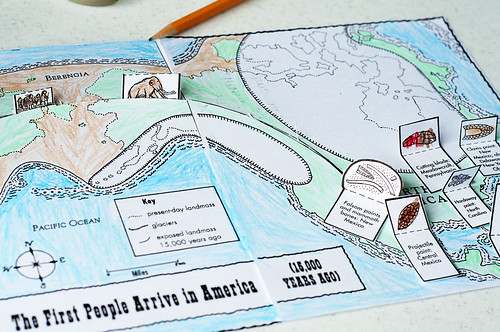
migrationmapAmerican History Interactive 3-D maps
This book has a 3-D map you can make that demonstrates the Bering Strait immigration theory (to the left there), along with maps to other major events in history.

The boys and I talked briefly about Central and South American natives - the Aztecs, Incas, and Mayans, of course. If I had found this book earlier, I would have read it aloud to them. We also briefly talked about the ancient North American Indians, but I still wish we'd had that book. (Spoiler #3! We have her books on explorers and colonists and I've read them, which is why I wish we'd had the earlier ones.)

We didn't spend an tremendous amount of time on this part of history. Much of it is still unknown and my kids didn't show much curiosity to know deeper details, which is my cue to move on. We're doing a timeline of U. S. history so it helps us keep better track of how the Native American history evolved from the ancient people to the more advanced civilization they had before 1492.

Now we're getting into the nitty-gritty of Native American history

Native Americans: An Inside Look at the Tribes and Traditions
This is a DK book. I like DK published kid books and so do my boys. This particular book was published back in 2001, so it lacks the latest in research on how America was first populated and I skipped the first chapter in the book. (We'd already covered the topic anyway.) I think this book does a good job of giving overall information on family, spiritual and daily life and then moves on to the regional area tribes. We read each chapter on the tribes, say on Northeast Woodland Indians, for example, and then detoured into region specific hands-on projects from....

Iroquois longhouse project
Easy Make and Learn Northeast Indians
We used several projects out of this that I felt reinforced important aspects of their history, such as their agricultural practices and how they lived in tune with the seasons. (Did I almost sound like I know what I'm doing or what?!) This teacher's website shows video examples of how he used these projects in his class. Again, my point in doing this specific work was not to make them memorize anything, but to help the boys understand how advanced of a society the Native Americans had before European "discovery." Oh, and to have some fun too...that's an important point.

and

Easy Make and Learn Southwest Indians
Dude, these people hunted rabbits by throwing sticks at them and picked prickly pear with these giant cactus tongs. Like, successfully! It blows our ever-loving Nintendo/microwave oven mind they were able to figure these things out and live. Who would have ever looked at a rabbit racing across the desert and thought, hmm, I'm gonna take this big stick, throw it at that motherfucker and kill it? Human ingenuity is astounding.

Northwest Coastal Cedar Plank House
Some of the projects in those two books can be used for other regional tribe studies, like the basket weaving or papoose project. I just realized that sentence sounds like something the head psychiatrist of a mental ward would say. Basket weaving? Total insane asylum activity. But some days it's hard to tell the difference between homeschool and the looney bin, so whatever.

This website has free printable projects too and we used the cedar plank house when we studied the Northwest coastal Indians. If you really want to flip your hands-on history lid, go to this website and follow the directions for building a wigwam. You learn how the Indians used math to build them.

If you really, really want to flip your history lid, make your kids construct you a real, live moon lodge where you can escape during your period and someone else does all of the child care, cooking and cleaning for you. I don't know how Native American women felt about this, and in my younger, single college days I thought this practice was very anti-feminist.  How dare those primitive men make women disappear during their period, as if they were tainted! But now I have a family and a home and enough dirty dishes in the sink to rival Mt. Everest and I'm all, HELL YEAH, I'M GOING TO THE MOON LODGE FOR THREE DAYS! I'm convinced this moon lodge thing is a version of heaven.

The Three Sisters
Native North American Foods and Recipes
We used this book along with the Northeast Indian Make and Learn book for more detailed information on how Indians cultivated crops and food (see picture to the right). We also used a book titled American Indian Science: A New Look at Old Cultures by Fern G. Brown for similar purposes. (Amazon doesn't have it, so no link.) I felt both of these were important in conveying the idea that this was a more advanced civilization than we assumed.

Nations of the Southeast
I selected this book because it's the area where we live. Our hands-on learning for this region comes from visiting actual historical sites in our area, so you wouldn't care about the details unless you live in the same area. Basically it includes planned field trips to historical sites with some reenactment festivals thrown in. Mix and bake for your area.

And so that's how I'm teaching U. S. history without using a textbook. You could also call this How a Recovering Overachiever Channels Her Need For Both Intellectual Challenges and Bucking The Status Quo. Stay tuned for Part II of this series - explorers! Or? Stay tuned for news of my commitment to the crazy farm where I attend basket weaving classes. It's a toss up.

(Did you make it to the end of this post? Good god, you deserve a gold star. If I gave those out. Which I don't. You should just feel good from the intrinsic motivation to better yourself.)

Wednesday, September 21, 2011

Six Places You Can Put Broken Crayons. (Hint: the sun doesn't shine there)

If there's one chapter in a homeschool book that could give homeschooling a bad name, it's this one....

Six Things To Do With Broken Crayons*

Look. I'm a homeschooler and even I don't want to homeschool after reading that title.  Is it a joke? Or an insult? I can't tell.

I put an indecent amount of creative energy into planning an interesting history curriculum and unique reading program that gives No Child Left Behind the finger. How about we throw just the broken crayons away? Because I'm an actual living, breathing person with average to above average cognitive function.

Okay, I'm being an asshole** and I admit it. I'm sure these six things to do with broken crayons are lovely ways to entertain yourself and your homeschooled children. You know, for when you aren't teaching them. Or cooking for them. Or washing their clothes. Or cleaning their nasty boy bathroom. Or preparing for tomorrow's lessons. Or reading their chapter book so you can intellectually participate in the book discussion. Or gathering supplies for next week's science labs. Or driving them to co-op class, fencing lessons, 4-H, chess club, field trips, junior master gardener classes, and drawing lessons. Use broken crayons to fill those "spare moments" that obviously abound when you homeschool.

I'm going to say it's okay to draw a line at how far you are willing to go when homeschooling and I personally draw it at finding ways to use broken crayons. I must have some boundaries...

Five Steps to Becoming Homeschool Teacher of the Year*

...and wha? You mean it's a competition against other homeschool moms who may or may not be better than me? Fuck.


*Yes, those are real chapters from a real book. No, I didn't read the book, because I'm an asshole. I'm sure the book is a lovely read to non-asshole homeschoolers.

** I'm especially an asshole when it's my turn to visit the Moon Lodge, which if you attended Heather's School of Awesomeness, you would learn a moon lodge is where Native American women went during their period. They were released from family and community responsibilities and sent off to a lodge to be by themselves, as in ALL ALONE WHILE OTHER PEOPLE TOOK CARE OF THEIR KIDS AND DIRTY DISHES, OMFG HOW GENIUS.

Tuesday, September 13, 2011

Fringe Benefits

I previously wrote of how homeschooling is hard, harder than anyone told me. Now I'm worried what I said in last week's post might discourage someone who is considering homeschooling. Because this new blog that I have barely done anything with yet and less than a dozen people read might be found in the millions and millions of other blogs and *poof!* I just disintegrated the hopes of a desperate mother whose kid is struggling in school. Then the Ghost of Heather's Public School Past will haunt me forever.

I need to make amends!

But I'm not going to lie and say it isn't hard. Or maybe challenging is the better word. If I were to rank the most challenging things I've done in my life, I'd list them like this...

1. Raising children
2. Homeschooling children
3. Staying happily married to the same man
4. Do-it-yourself bikini waxes

Yes, I put homeschooling above the difficulty of staying happily married.  Who has time to even question the state of their marriage when you homeschool. I'm always at the printer.

Homeschooling is hard. But it's not.

And I've been sitting on the post for days and days now, trying to find a way to articulate how homeschooling isn't hard. Maybe it's because homeschool "success" is hard to measure. Or maybe because homeschool is just another name for self-inflicted psychosis. Because, seriously? This is not something a sane person would do.

Good, I said it. I hope I have scared away all the faint of heart and weak-minded. And maybe I even scared away some of my former public school PTA buddies/teachers too.

Now that all of those people are gone, I can say this:

Homeschool is one of the most unbelievably awesome things I've ever done.

I wish I could articulate exactly why. Part of it is seeing my oldest son discover there are not just one or two kind kids, but an entire group of kind, accepting, friendly kids.

Part of it is having the authority to say, whoa little 8-year-old dude, writing this many paragraphs stresses you out and makes your handwriting revert to a preschool level? Watch me use my superpower called COMMON SENSE and magically BACK THE FUCK OFF until you are developmentally ready for this. Because, really, who cares if you learn to write five paragraph essays in the 3rd grade versus 5th grade.* It doesn't matter to the person who will accept you into college!

Another part of the awesomeness is realizing it's more important to teach how to tap into the creative process than to teach them to write five completely dry, boring, uncreative paragraphs just to fill a word quota.

I would be remiss if I didn't also say a great part of homeschooling is my 5th grader not having two hours of homework every night. Which, I'm sorry, people think homeschoolers are weird and unnatural? That shit is unnatural. That's robbing a childhood.

Which leads me to say I love that I'm able to let my kids be kids. Not stressed-out miniature adults expected to work for eight hours a day. Kids. That's all I require them to be for now.

Well, that and my own personal window-washer/laundry folder.

Homeschool lesson of the day: A lot of it is about the fringe benefits.

*I have more to say about our experience with teaching writing. But first I have a two-sided paper jam in my printer. Damn it!

Thursday, September 8, 2011

"Homeschooling Is Not That Hard" Oh Really?


There’s nothing like spending 48 rainy day hours planning a chemistry curriculum that signals you have officially reached HOMESCHOOL INSANITY LAND. The good news is I had company. Yes, thanks to a tropical storm and extended holiday weekend, Wally visited this magical land with me, where flipping through six different science books to piece together one cohesive chemistry unit is valued above all other things, including opening college football weekend.

Wally, bless his heart, is naïve in the way of life in HOMESCHOOL INSANITY LAND. He exposed himself as a tourist when he said this….

“Ooooo! I didn’t know our printer printed two-sided!”

To which I replied, “Yes, it does. As long as you print one page, get up, flip the printed paper, slide it on top of the paper tray, go back to your computer, print the second page on the opposite side and then go back to the printer and get your two-sided paper.”

And people wonder why homeschooling takes up so much of my time.

For reasons I don’t understand, science is the subject that seems the most difficult for homeschooling. Along with grammar. And writing. And history. And vocabulary. And P.E.

Fuck, okay, it’s ALL DIFFICULT.

I remember, in my initial days of simply asking around about homeschooling, people would tell me, “oh, it’s not that hard…” Now I look back on these people as if they are foreigners not only speaking a different language but also wearing their underwear on the outside of their clothes.

What the hell, you crazy underwear people? Does your definition of “not difficult” change once you begin homeschooling? Kind of like your scale of pain tolerance changes after giving birth to a nine and a half pound baby without an epidural? Your tolerance for the difficulty of raising children expands to the Nth power once you begin homeschooling. That’s it, isn’t it?

What could be difficult about vocabulary, though? Honestly, give them some words and they learn the definition. They even make (gasp!) workbooks for that. Easy peasy!

Yes, yes it was. At first a workbook sufficed. But as we slowly disengage from the public school mindset and embrace new ways of learning, workbooks no longer suffice. And so it’s back to the drawing board for vocabulary.

Rinse and repeat for spelling.

And grammar. Oh, grammar. Something that should be easy, second only to math in sequential learning! Except, you know. Workbooks. No longer appealing! So I buy a curriculum that isn’t workbook based and I’m like, huh? What? How do I implement this free-range style grammar program?!? I wasn't raised this way! 

I'm learning all over again too.

I could tell the slightly different versions of the same story for each subject. Writing is difficult because my boys hate writing (thank you, public school system). P.E. is difficult because it’s summer in the deep South (read: death by humidity and high temperatures). History is difficult because apparently my standards for “good curriculum” are very high (interesting factual reading, hands-on and interactive learning. And something other than the European white man’s version, please!).

“Oh, it’s not that hard…”

Homeschool lesson of the day: Don't trust people who wear their underwear on the outside of their clothes. 

Thursday, March 24, 2011

The Learning Never Stops

Matt just had a great lesson in Home Ec. And when I say great lesson in Home Ec, I mean I made him mop my bathroom floor. So when all of those homeschoolers tell you homeschooling is fabulous, this is what they mean. You make your kids do housework and call it Home Ec. When someone clogs the toilet, you make your homeschool kid unclog it and call it Introduction to Plumbing.

Of course, when I said I "made" him mop the floor, I didn't actually make him. He ASKED to do it. THUD!, right? Whose kid does that?!

Mine does.

And now we're going to pretend his awesomeness is all due to my fantastic parenting skills. Disclaimer: Jamie's dirty clothes piled MILES HIGH on his floor do not reflect my parenting skills. Neither does his current annoying cocky attitude. I'm going to blame that on public schools.

Immediately following mopping, Matt wants to discuss whether endangered insects would be protected under the Endangered Species Act, even if they are harmful to crops. Would people be motivated to save a living species if it doesn't benefit them to do so? If no, is that fair. What if the insect has a benefit to our environment we aren't aware of. The circle of life, after all!

I'm telling you, the learning never stops around here. Never. Stops. Never. Ever. OMFG.

Next lesson up - Bartending 101.

Saturday, March 5, 2011

Nerds and Birds (ad infinitum)

6:30 am. The questions start. Birds.

8:00 am. More questions. Birds.

9:30 am. Math time. More questions. About birds.

9:32 am. Birds! 

9: 37 am. Still math time. Still more questions. About birds.

11:00 am. It's history, but can we talk about birds? Yes, of course we can. Because I can't get enough of birds. 100 million questions a week about birds is not enough. Homing pigeons were used in WWI? Awesome. Let's research and study that for two years!

12:00-1:00 pm. No questions about birds because we're watching The Daily Show and The Colbert Report.

This one hour that could be my down time, my time to decompress and de-mom, is spent sitting and monitoring television content, ready to turn it off if Stephen starts talking about porn yet AGAIN. When they mention kinky sex monikers in passing and I get asked what they are talking about, I play dumb. "Anal pounding? Wha? I have NO IDEA what they are talking about. Sometimes they combine words which have no meaning just to sound funny." I'm getting so good at playing dumb about sex that I'll be nominated for an Oscar soon.

I probably shouldn't let him watch these shows at all. But I do. I do because I have this child that is not like a child. A child that I sometimes have to explain (and reexplain again and again) the simplest social formality to, yet also completely understands the political satire of Jon Stewart and Stephen Colbert, who laughs in all the right places - without explanation. Unless they talk about porn. Then I play dumb and turn it off until the segment is over.

1:00 pm Birds! Love to ask a zillion question about birds! And our weird Mexican neighbor who doesn't speak English but has pigeons and chickens and turkeys - let's go visit him! Never mind the viscous German shepherd - he has a DOVE COTE, OMG WET MY PANTS!

1:07 pm. Can I have a pet bird?

1:15 pm. Pet birds are great. Don't you want one? Birds, birds, birds, birds, birds, birds, birds, birds, birds.

2:00 pm. Birds, birds, birds, birds, birds, birds, birds, birds, birds, birds, birds, birds, birds, birds, birds, birds, birds, birds, birds, birds, birds, birds, birds, birds, birds, birds, birds, birds, birds, birds, birds.

3:00 pm. Time to go pick up your brother! Birds, birds, birds, birds, birds, birds, birds, birds, birds, birds, birds, birds, birds, birds, birds, birds, birds, birds, birds, birds, birds, birds, birds, birds, birds.

3:15 pm After school snack. Sibling warfare commences.

3:30 pm birds, birds, birds, birds, birds, birds, birds, birds, birds, birds, birds, birds, birds, birds, birds, birds, birds, birds, birds, birds, birds, birds, birds, birds, birds, birds, birds, birds, birds, birds, birds.

4:00 pm. (Do I even need to write it?)

5:00 pm. Wally calls. "Honey, I'm working late tonight!" Motherfucker. My 6-8 pm bird deflector shield has abandoned me. 

5:05 pm. Birds, birds.......I'm sick of typing it.

6:00 pm Birds ad infinitum 

6: 30 pm. And again.

7:00 pm. OOOH! NOVA night on PBS! Sweet baby Jesus, there is a God after all!

7:00 - 9:00 pm. No birds.

9:00 pm. Bed time. I DON'T dream about birds.

6:30 am the next day. Repeat previous day.